
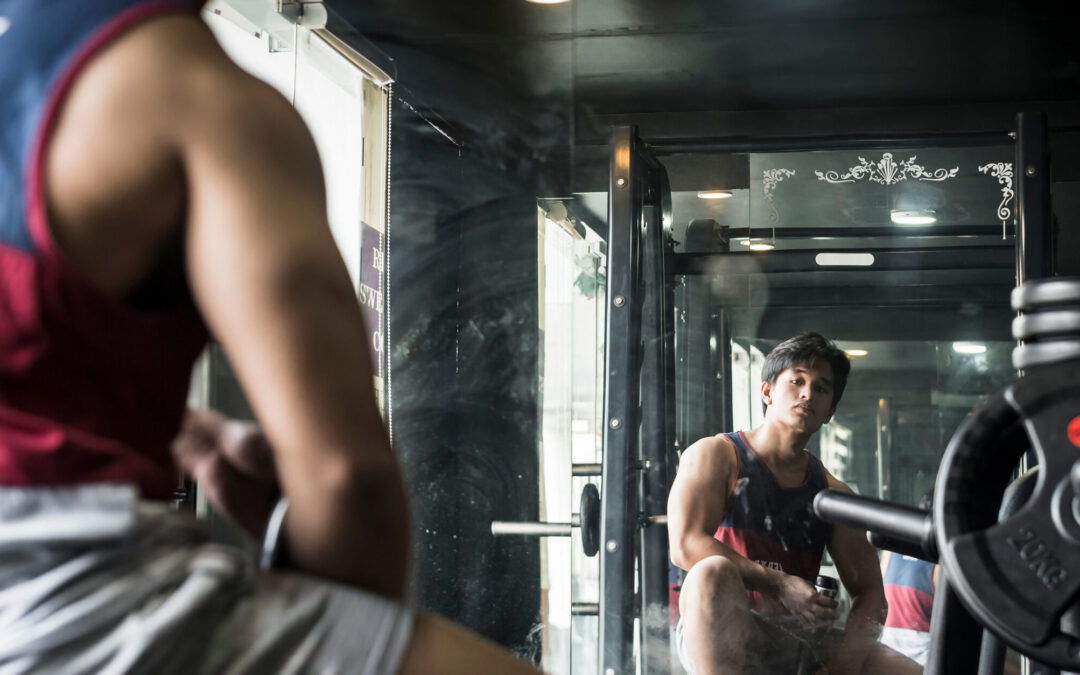
Most people know about anorexia. But a lesser-known disorder is surging among boys and young men, and it’s largely invisible. It’s called muscle dysmorphia (nicknamed “bigorexia”) and it’s reverse anorexia. Boys and young men see themselves as too small, too weak, too skinny, even when they’re objectively muscular. They become obsessed with building more muscle, trapped in a distorted mirror that never shows them what they actually look like.
Recent research found 2.8% of boys and men ages 15-35 in the U.S. and Canada meet diagnostic criteria for muscle dysmorphia. That’s roughly one in every 35. Among competitive bodybuilders, up to 54% show signs of the disorder. It typically starts in mid-to-late adolescence, exactly when puberty, peer comparison, and social media pressure converge into a perfect storm of body image crisis.
The Bodybuilder Who Sees Himself as Scrawny
Muscle dysmorphia is a form of body dysmorphic disorder. The afflicted person becomes preoccupied with the idea that their body isn’t muscular enough. They believe they’re smaller or less muscular than they actually are, even with clear evidence to the contrary. A teenager with a bodybuilder’s physique will look in the mirror and see someone frail and underdeveloped.
Actor Justin Baldoni described his own struggle with what he believes is muscle dysmorphia in an interview with Cosmopolitan: “No matter what I do, I never feel like I’m strong enough, or muscular enough or big enough, and that comes down to being the super skinny kid that was picked on and bullied.” His experience captures the core psychological pattern — the disorder often roots in childhood bullying or body shaming that creates a persistent distortion in self-perception.
Research shows 25% of adolescent males worry about not having enough muscle. Nearly one-third of boys ages 11-18 are dissatisfied with their body shape. But this isn’t just a teenage problem — the disorder persists into young adulthood. Among men in their twenties and early thirties, the same distorted self-perception drives excessive gym time, rigid diets, and steroid use. These numbers suggest a much larger population struggling with muscle-focused body image concerns, even if they don’t meet full diagnostic criteria for the disorder.
Why It’s So Hard to Spot

The disorder goes unnoticed because the behaviors look healthy. Working out regularly? Great. Eating lots of protein? Perfect. Concerned about nutrition? Responsible. The problem is when these behaviors become compulsive, rigid, and start causing significant impairment in daily life.
Boys and young men with muscle dysmorphia spend all their waking hours exercising and feel intense guilt if they miss the gym. They stop eating with family or friends because of inflexible concerns about their diet. They accumulate excessive amounts of protein powders, supplements, and bodybuilding products. They check their bodies constantly in mirrors, comparing themselves to others, never satisfied with what they see.
Gym culture makes it worse. These obsessive behaviors are celebrated in fitness spaces. Spending three hours at the gym every day gets applause, not concern. Restricting entire food groups for muscle gain is standard bodybuilding practice. Steroid use becomes normalized. Parents and even healthcare providers struggle to distinguish healthy fitness enthusiasm from pathological obsession.
Social Media Is Feeding the Crisis
The average teenage boy and young man is now bombarded by images of superhero-like physiques and “fitspiration” content. Social media influencers promote unrealistic body standards, often achieved through extreme measures they don’t disclose. Seeing these images causes boys and men to develop harmful thoughts about needing to change their bodies. They start training more intensely, worrying obsessively about body fat, restricting their diets. Soon the training becomes excessive and compulsive.
A 2019 study found 22% of adolescent boys engaged in muscularity-oriented disordered eating behaviors — using supplements, making extreme dietary changes, even turning to steroids in attempts to bulk up or gain weight. Male eating disorder hospitalizations have risen dramatically since 2002 according to recent Canadian research, yet the condition remains under-recognized and under-diagnosed.
Boys and young men with muscle dysmorphia are at higher risk for depression, anxiety, substance abuse, and suicide. Many hesitate to seek help due to shame, secrecy, or because the behaviors are normalized in their communities. The disorder becomes invisible — celebrated as dedication rather than recognized as pathology.
What the Warning Signs Look Like
The key indicators emerge when someone develops a preoccupation or obsession with weight, food, exercise, or appearance in a manner that worsens quality of life and impairs social, school, or daily functioning. This applies whether someone is a teenager or in their twenties. Warning signs include refusing to miss workouts even when injured or sick, avoiding social situations that interfere with gym time or diet plans, expressing persistent dissatisfaction with body size despite being muscular, and engaging in excessive body checking or comparison behaviors.
Changes in eating patterns matter too. Boys and young men might significantly increase protein intake while restricting carbohydrates or fats to extremes. They may develop rigid eating schedules or rituals around food. They might refuse to eat with others because they can’t control the meal precisely. Accumulating large quantities of supplements, protein powders, or bodybuilding products beyond what’s reasonable for healthy fitness is another red flag.
The key distinction between healthy fitness interest and muscle dysmorphia is impairment. Plenty of teenage boys and young men work out regularly and care about their appearance — that’s normal. It becomes a disorder when the preoccupation causes significant distress, when they skip important life events because they conflict with the gym, when they can’t stop even though it’s causing problems. out regularly and care about their appearance — that’s normal.
It becomes a disorder when the preoccupation causes significant distress, when boys skip important life events because they conflict with the gym, when they can’t stop even though it’s causing problems.

What Can Actually Help
If someone is struggling, the most important step is seeking professional help. Muscle dysmorphia is best supported by an interdisciplinary team including mental health, medical, and nutrition providers. A primary care doctor can provide initial assessment and referrals.
For those close to someone showing signs, there are ways to help counteract the forces fueling body image issues. Limiting social media consumption helps, while recognizing it can’t be eliminated entirely. Talking about what’s being seen online matters — discussing how fitness content is interpreted, making sure the reality behind social media images is understood. The editing, the angles, the performance-enhancing drugs many influencers use but don’t disclose.
Modeling healthy behaviors matters too. Avoiding comments about body size or appearance, whether about yourself or others. Supporting a broader concept of masculinity that doesn’t center entirely on physical strength or muscularity. Creating opportunities for identity and confidence to develop through activities that have nothing to do with appearance.
The earlier muscle dysmorphia is addressed, the better the outcomes. Left unchecked, the consequences can be life-altering. Boys and young men deserve to see themselves accurately, to pursue fitness without obsession, to build healthy relationships with their bodies that don’t require constant mirror checks and persistent dissatisfaction. Recognizing the signs means intervention can happen before the disorder becomes entrenched, before the distorted mirror becomes the only reflection they can see.