
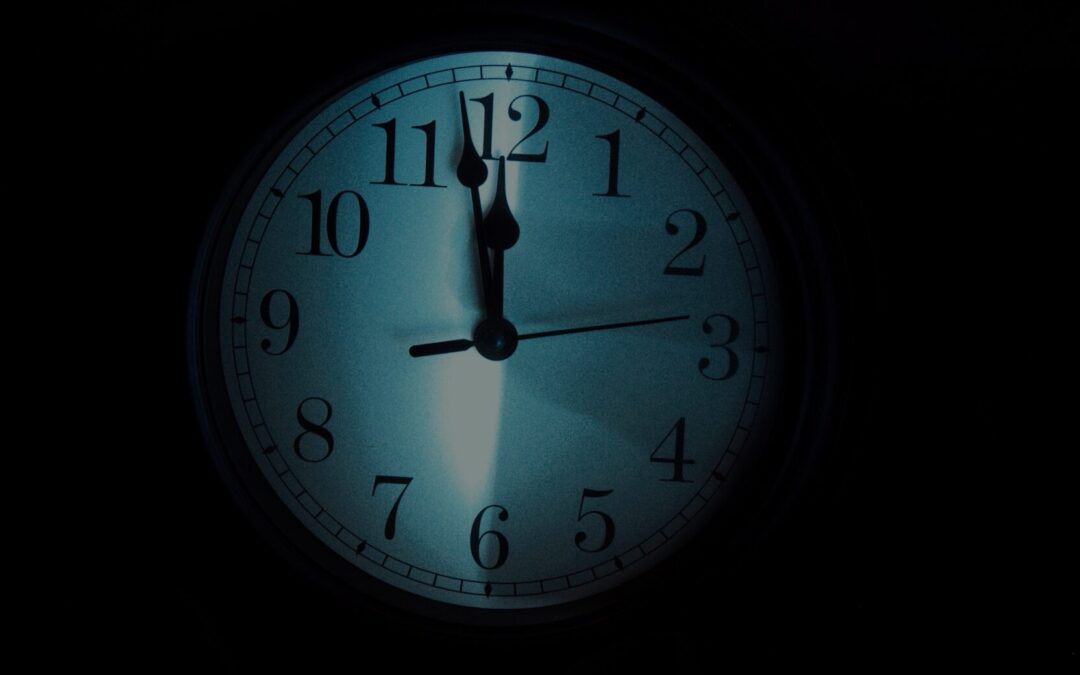
Last week, a group of scientists moved the hands on a clock that’s been ticking since 1947. It now reads 85 seconds to midnight — the closest it’s ever been to symbolic annihilation. If you’ve heard of the Doomsday Clock but never quite understood what it actually means, you’re not alone. The metaphorical timepiece makes headlines annually, yet its purpose and methodology remain surprisingly opaque to most people watching the countdown.
The clock isn’t predicting when disaster will strike. It’s measuring how close we are to creating it ourselves.
An Artist’s Deadline
In 1947, the Bulletin of the Atomic Scientists needed a magazine cover. They’d just formed after witnessing what their Manhattan Project work had wrought in Hiroshima and Nagasaki. The group included Albert Einstein, J. Robert Oppenheimer, and dozens of physicists suddenly grappling with having built civilization-ending weapons.
They commissioned Martyl Langsdorf, a painter married to physicist Alexander Langsdorf Jr. She initially considered using the uranium symbol. But listening to the scientists debate their moral responsibility, she felt their urgency differently. She chose a clock instead, sketching her idea on the back of Beethoven’s Piano Sonatas.
The original setting? Seven minutes to midnight. When asked why, Langsdorf admitted she picked it because “it looked good to my eye.” There was no algorithm, no probability calculation. Just an artist’s instinct about how much space felt appropriately alarming.
When Midnight Moved
Editor Eugene Rabinowitch never planned to adjust those hands. The clock was meant as a static warning. But in October 1949, the Soviet Union tested its first atomic bomb. The arms race the scientists feared had officially begun. Rabinowitch moved the clock to three minutes before midnight, and a tradition was born.
The Doomsday Clock has been reset 26 times since 1947. Each adjustment reflects the Bulletin’s Science and Security Board assessment of existential threats — initially nuclear weapons, later expanding to include climate change in 2007, then biotechnology threats, artificial intelligence, and disinformation.
The clock reached its farthest point from catastrophe in 1991, sitting at 17 minutes to midnight. The Cold War had ended. The United States and Soviet Union signed the Strategic Arms Reduction Treaty, committing to deep cuts in nuclear arsenals. Optimism felt justified.
The Shift to Seconds
Until 2017, the clock only moved by minutes. But as threats accelerated and compounded, minutes felt inadequate. The board started counting seconds. In 2020, it moved to 100 seconds. In 2023, 90 seconds to midnight. Last year, 89 seconds. Last week’s four-second leap to 85 seconds marks the smallest adjustment yet — and the most alarming position in the clock’s history.
Why now? The board cited escalating nuclear tensions, with the New START treaty between the United States and Russia expiring soon. Climate change continues accelerating. But newer threats drew particular concern: artificial intelligence deployed in warfare without adequate safeguards, biological technology risks including synthetic biology, and the erosion of international cooperation needed to address any of these problems.
Daniel Holz, the University of Chicago astrophysicist who chairs the Science and Security Board, described the moment starkly: “When you are at this precipice, the one thing you don’t want to do is take a step forward.”
What Midnight Actually Means
Here’s where things get philosophically murky. Ask board members to define midnight precisely and they demur. Climate scientist Inez Fung, serving her second year on the board, turned the question around: how many people would have to die before we’d call it catastrophe? The board deliberately avoids quantifying that endpoint.
The clock represents urgency, not prediction. It’s a political tool disguised as scientific measurement. The board — which includes eight Nobel laureates — meets twice yearly behind closed doors. They review threats, debate severity, consult experts globally, then reach consensus on whether the hands should move.
Critics call it theater. Steve Goldstein, MarketWatch’s European bureau chief, dismissed it as “statistical nonsense,” arguing that given the probabilities implied by the clock’s movements, we should already be extinct. Others suggest mixing nuclear risks with climate change and AI creates a “grab bag of threats” that induces paralysis rather than action.
When Scientists Count Individual Seconds
The Bulletin acknowledges the clock is metaphorical. But metaphors shape behavior. The clock drives more traffic to the Bulletin’s website than any other feature. Policymakers reference it in debates. Robert Socolow, Princeton professor emeritus, captures the contradiction: “Here’s a very quantitative group of people choosing not to use very quantitative methods.” Scientists deliberately operating outside pure science to create visceral warning.
The clock’s power lies in its simplicity. You don’t need to understand nuclear arsenals or climate tipping points to grasp that 85 seconds isn’t much time. That’s the point.
Last week’s announcement included actions that could move the clock backward — resume U.S.-Russia nuclear talks, prevent AI-driven biological threats, establish multilateral limits on military AI. Whether any of that happens remains uncertain. The clock has moved steadily closer to midnight for decades, with only brief retreats. We’re now counting individual seconds, a granularity suggesting the board is running out of larger units to adjust.
Martyl Langsdorf died in 2013, decades after sketching that first clock. She never could have predicted her design would become an enduring symbol of human-created peril. She just knew scientists were panicked, and panic needs imagery that cuts through. At 85 seconds, we’re closer to midnight than at any point since 1947, and unlike Langsdorf’s original artistic choice, there’s nothing arbitrary about the direction those hands are moving. point since 1947. The clock hands keep ticking forward, and unlike Langsdorf’s original artistic choice, there’s nothing arbitrary about the direction they’re moving