Have you tried antidepressants that either didn’t work or made things worse? Maybe one made you anxious, another left you emotionally numb, and a third gave you nightmares. You’re not alone. Nearly one-third of the 332 million people worldwide with depression don’t respond to conventional treatments.
Now there’s a treatment that puts half of people with treatment-resistant depression into remission — in just five days.
SAINT: Five Days Instead of Six Weeks
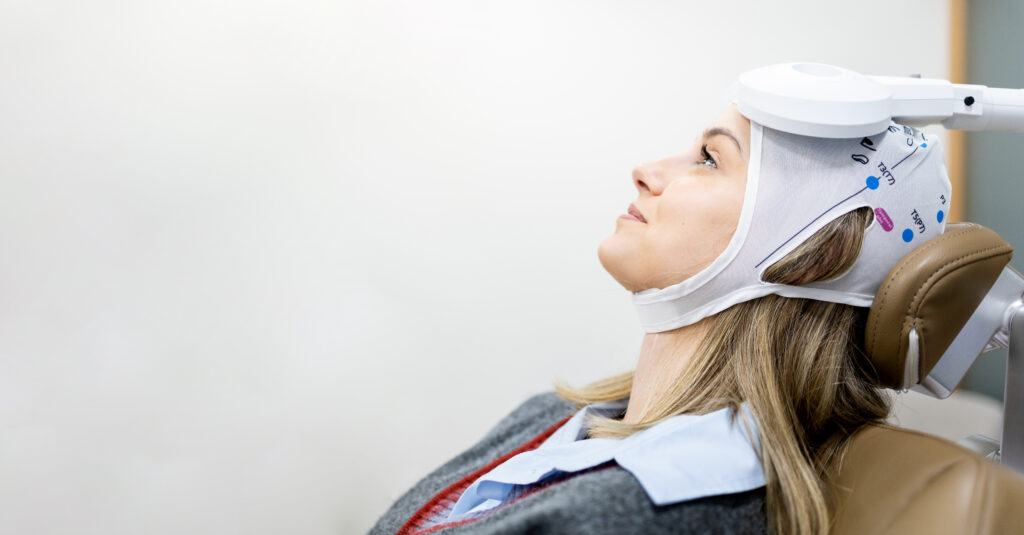
Stanford Accelerated Intelligent Neuromodulation Therapy, or SAINT, sounds like science fiction but it’s FDA-cleared and available at 17 clinics across the United States. The treatment uses magnetic pulses to stimulate targeted regions in your prefrontal cortex, the brain area responsible for emotional regulation.
A new study published in World Psychiatry found that 50% of participants achieved remission one month after treatment, compared to 21% who received placebo treatment. Earlier trials showed even higher rates — 79% remission in some studies.
What makes SAINT different from traditional transcranial magnetic stimulation? Speed and precision. Traditional TMS requires hour-long sessions five days a week for six weeks. SAINT delivers ten 10-minute sessions daily for five consecutive days, and uses MRI scans to target the exact spot in your brain that needs stimulation.
Eight Medications, Nothing Worked
Valerie Zeko spent years searching for an antidepressant that worked. Her doctor prescribed bupropion first, which gave her energy but also anxiety. Then she and her psychiatrist tried seven more medications over several years.
“They just either didn’t work at all, made it worse, made me feel suicidal,” Zeko told CNN. She experienced urinary issues, headaches, nightmares, emotional numbness, and crushing fatigue. By 2023, she was desperate.
After receiving SAINT treatment at Stanford’s Brain Stimulation Lab, something shifted within days. That Thanksgiving, her family rented e-bikes and rode across the Golden Gate Bridge — an activity she’d done before but never enjoyed.
“This time, it was a whole different experience,” she said. “I want to do everything that I have always done again, because it’s so much better now.”
Magnetic Pulses Target the Exact Problem Spot
Before treatment starts, you get a functional MRI that maps how different parts of your brain communicate. The scans identify the strongest connection between your left dorsolateral prefrontal cortex and a deeper region called the subgenual cingulate, which is associated with depression.
Technicians send thousands of rapid magnetic pulses to that precise location through an electromagnetic coil on your scalp. These signals strengthen the connections, treating depression at its neurological source. Some patients feel nothing during treatment. Others feel brief discomfort — Zeko described it as her brain snapping back like a rubber band.
$16,000 to $36,000 Without Insurance
Without insurance, SAINT costs between $16,000 and $36,000. Medicare now covers it in hospital-based outpatient settings as of July 2025, and some private insurers are beginning to offer coverage. But most insurance companies don’t yet cover it, making cost the biggest barrier.
Only 17 clinics currently offer SAINT through Magnus Medical, the company holding the license. That number is expected to double by the end of 2026, but for now, access remains limited.
Some People Need Multiple Rounds
SAINT isn’t a permanent cure for everyone. Some people remain in remission for months or years after one treatment course. Others need occasional tune-ups to stay symptom-free. Zeko felt great for over two years but started experiencing symptoms again in the past six months — though that might be from job stress rather than relapse.
One trial participant called Willow responded well initially but saw symptoms return after five months. She got a second round that lasted six months. Since October 2024, she’s managed her depression with weekly ketamine treatments.
Dr. Brandon Bentzley, SAINT’s lead developer, explained that some people need more than just neurobiological treatment. They also need psychological support, occupational therapy, and time to relearn how to live without depression.
When Psychiatry Might Actually Change
The bigger question is whether SAINT represents a fundamental shift in how psychiatry treats depression. Traditional treatment algorithms start with antidepressants, then try different medications, then consider brain stimulation only after multiple failures.
SAINT’s rapid results — relief within days rather than weeks — suggests it could move earlier in that sequence. But whether it should be a first-line treatment hasn’t been studied yet. Awareness remains the biggest hurdle: only 0.7% of people who need transcranial magnetic stimulation currently get it, despite two decades of FDA clearance.
If you’ve cycled through multiple antidepressants without relief, SAINT might be worth discussing with your psychiatrist. The treatment isn’t available everywhere, and the cost is prohibitive for many. But for people who’ve exhausted conventional options, a five-day treatment that works for half of participants could be worth exploring.