
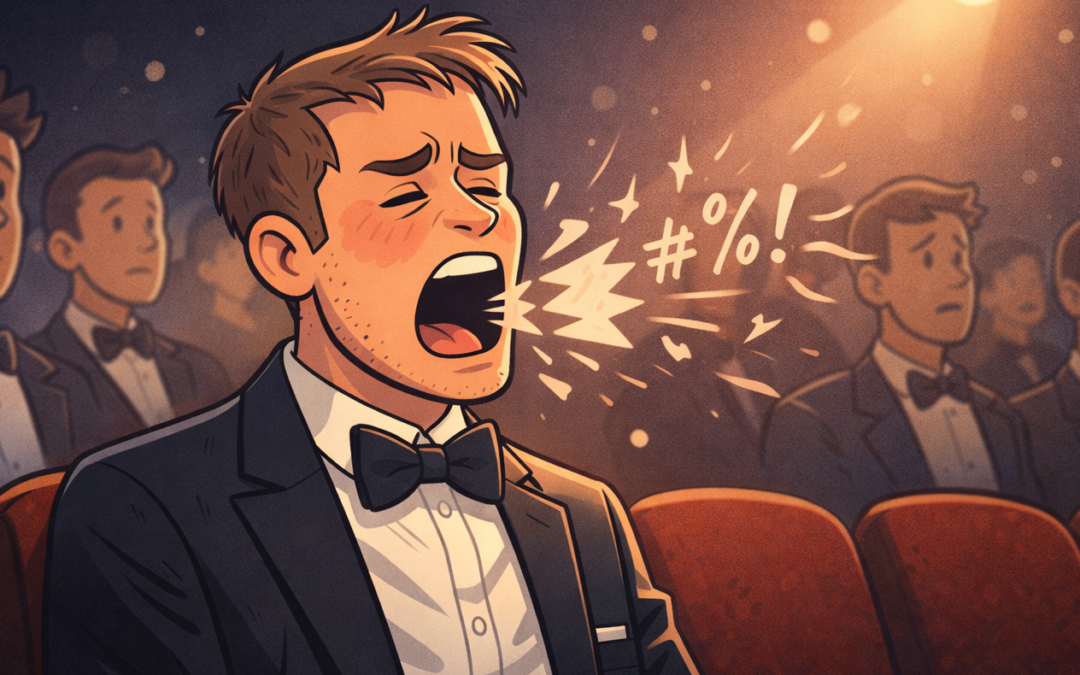
On February 22, John Davidson sat in the audience at the BAFTA Film Awards in London — the same ceremony honoring the film his life inspired — and involuntarily shouted a racial slur while two Black actors were presenting onstage.
The moment was broadcast on a two-hour delay. The BBC left it in. The backlash was immediate and, for Davidson, not unfamiliar. He has spent decades as one of Britain’s most prominent Tourette syndrome advocates, received an honor from Queen Elizabeth II in 2019 for that work, and has spent most of his adult life navigating exactly this kind of public misunderstanding.
“My tics have absolutely nothing to do with what I think, feel or believe,” Davidson told Variety afterward. “Those words are not an intention, not a choice and not a reflection of my values.”
What happened at the BAFTAs was not a controversy about a person’s character. It was a collision between a neurological condition and a public that still fundamentally misunderstands it.
Most People With Tourette’s Never Swear Involuntarily
The most persistent myth about Tourette syndrome is that it causes people to shout obscenities. It doesn’t — at least not usually. Tourette’s is a neurodevelopmental condition affecting roughly 0.5% to 0.7% of the population, characterized by involuntary movements and sounds called tics. The most common tics are things like eye blinking, throat clearing, shoulder shrugging and brief sounds. Most people with the condition will never experience what Davidson has.
The specific symptom on display at the BAFTAs — involuntary obscene or offensive speech — is called coprolalia. Only about 10 to 20% of people with Tourette syndrome experience it. The condition’s media reputation has been built almost entirely on this minority symptom, which is why most people’s mental model of Tourette’s looks nothing like the actual disorder most people live with.
Why the Brain Targets the Worst Possible Words
The neuroscience here is genuinely strange. Tics arise from dysfunction in neural circuits involved in movement and impulse control — the brain’s inhibitory systems misfiring in ways that produce involuntary motion or sound. But why profanity specifically? Why slurs?
Taboo words are emotionally charged and socially loaded, which means they’re more strongly encoded in the brain’s language and emotional networks than neutral words. The brain’s emotional architecture essentially makes forbidden language more memorable — and therefore more available to a misfiring inhibitory system. This is why coprolalia can also occur, rarely, in people with brain lesions or seizure disorders entirely unrelated to Tourette’s.
The cruelest irony, noted consistently in research, is that tics often compel people to say or do precisely what they most wish to avoid. One interview participant in a sociologist’s research on coprolalia stigma described it this way: “It’s like my brain weaponizes my most polite intentions and turns them into the cruelest things.”
The Premonitory Urge and the Myth of Control
A common assumption is that people with Tourette’s could stop their tics if they really tried. The reality is more complicated. Many people feel a building sensation before a tic called a premonitory urge — described as an itch that needs to be scratched — and some can temporarily suppress the tic, but usually at the cost of significant discomfort and a more forceful tic later. Others experience tics suddenly, with no warning at all, like an unexpected sneeze.
Davidson described exactly this at the BAFTAs: the shame hitting immediately, the attempt to calm himself, the decision to leave the room to avoid further disruption. “I wanted the floor to swallow me up,” he said. The cost of that evening was not just embarrassment. For many people with taboo tics, it is the daily weight of a life spent managing other people’s reactions to a condition they didn’t choose and can’t reliably control.
The Stigma Does Serious Damage

The social consequences of Tourette syndrome, particularly for those with coprolalia, are significant and well-documented. Research shows around 70% of people with Tourette’s struggle with anxiety disorders, and one in three experience depression. One in four adults with the disorder has attempted suicide.
These numbers are not incidental to the stigma. Exclusion, bullying, barriers to employment, and the psychological toll of constant social vigilance all compound over time. Rena Zito, a sociologist at Elon University who studies Tourette’s stigma and lives with the condition herself, notes that families also absorb the weight — feeling judged in public, unsupported by schools, and helpless in the face of their child’s distress.
A Moment That Deserved More Than a News Cycle
The BAFTA incident generated enormous online commentary, most of it missing the point. The more useful conversation is the one it could prompt: about what Tourette syndrome actually is, how the brain works when its inhibitory systems fail, and what it costs a person to move through a world that treats a neurological misfire as a moral failing.
Davidson has been having that conversation for thirty years. The BAFTA audience just made it louder.