

You’re sitting across the table from someone on a first date. They’re saying all the right things, checking all the boxes on paper. But something feels off. You can’t explain it, but your stomach is telling you to run. Later, you’ll describe this moment by saying “I just had a gut feeling.”
Turns out, you weren’t speaking metaphorically. Your gut was literally talking to you.
Your Gut Has 500 Million Neurons
Scientists have discovered that your digestive system contains an entire neural network with more than 500 million neurons — more nerve cells than anywhere else in your body outside of your brain. This network, called the enteric nervous system, is so complex and sophisticated that researchers now call it your “second brain.”
This second brain doesn’t just process your lunch. It gathers information about conditions inside your gastrointestinal tract, processes that information locally, and generates responses — often without sending anything back to your actual brain for approval. It can operate semi-independently, making decisions about digestion, immune responses, and even mood-affecting chemical releases.
The connection between your two brains is constant and bidirectional. More information passes between your brain and gut than between your brain and any other body system. The main link is your vagus nerve, which acts like a high-speed data cable running signals in both directions.
Why Your Stomach Reacts to Stress
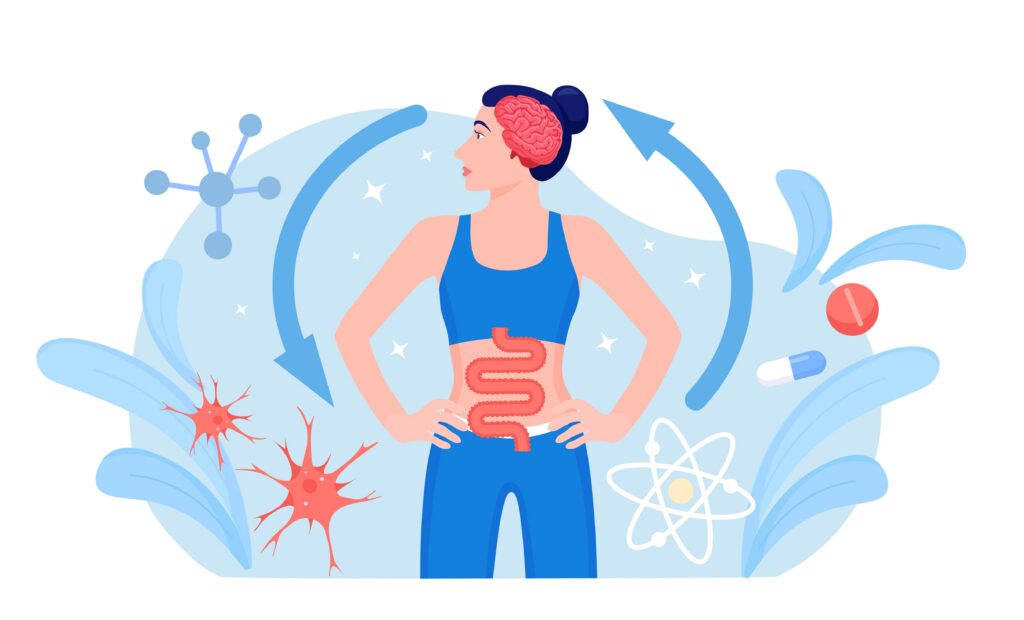
Remember those butterflies before a big presentation? The gut-wrenching feeling when you hear bad news? The nausea before a difficult conversation? That’s your brain talking to your gut through the vagus nerve, and your gut responding by changing its physical behavior.
When your brain perceives stress or threat, it sends signals down to your gut that can alter everything from digestion speed to immune function. Your gut responds by sending signals back up to your brain about its internal state. This creates a feedback loop that can intensify both your emotional experience and your physical sensations.
The emotional part of your brain evolved this tight connection with your digestive system to help you survive. After eating something that made you sick, your emotional brain kicks in to help you remember to avoid that food in the future. The more intense the physical sensation in your gut, the stronger the emotional memory. This is why disgust is such a powerful emotion — it’s directly wired to your survival instincts.
The Bacteria Making Decisions for You
Here’s where it gets genuinely weird: the bacteria living in your gut are also part of this conversation. Your gut microbiome — the trillions of microorganisms in your digestive system — produces or helps produce many of the chemical neurotransmitters that carry messages between your gut and brain.
These microbes create chemicals that can affect your brain through your bloodstream. They influence everything from your mood and stress levels to your food cravings and decision-making. Your brain and gut, in turn, can affect your microbiome by altering its environment through stress hormones and digestive changes.
Research has shown significant overlap between people who have functional gastrointestinal disorders like irritable bowel syndrome and people who have mental health conditions like anxiety disorders. The connection isn’t coincidental — it’s biological. When one system is out of balance, it affects the other.
What This Means When You Make Decisions
So when you say you’re “going with your gut,” you’re not just using a figure of speech. Your enteric nervous system is processing information about your internal state — physical sensations, chemical signals from your microbiome, emotional feedback from your brain — and integrating all of it into a signal that reaches your conscious awareness as a feeling.
That feeling isn’t always right, of course. Your gut can be influenced by things like hunger, stress, poor sleep, or an imbalanced microbiome. But it’s also processing information your conscious brain might have missed. It’s reading subtle cues your rational mind hasn’t put together yet.
The key is learning to distinguish between anxiety-driven gut feelings and genuine intuition. Anxiety tends to create constant, generalized tension. Real gut feelings are usually specific, situational, and come with a sense of clarity even if you can’t explain the reasoning.
Healthcare providers are now experimenting with treating mood disorders and cognitive issues by treating the gut microbiome with probiotics, specific diets, and even fecal microbiota transplantation. If your gut health affects your brain health, then fixing one might help the other.
The next time you have a gut feeling about something, pay attention. Your second brain might be telling you something your first brain hasn’t figured out yet.