

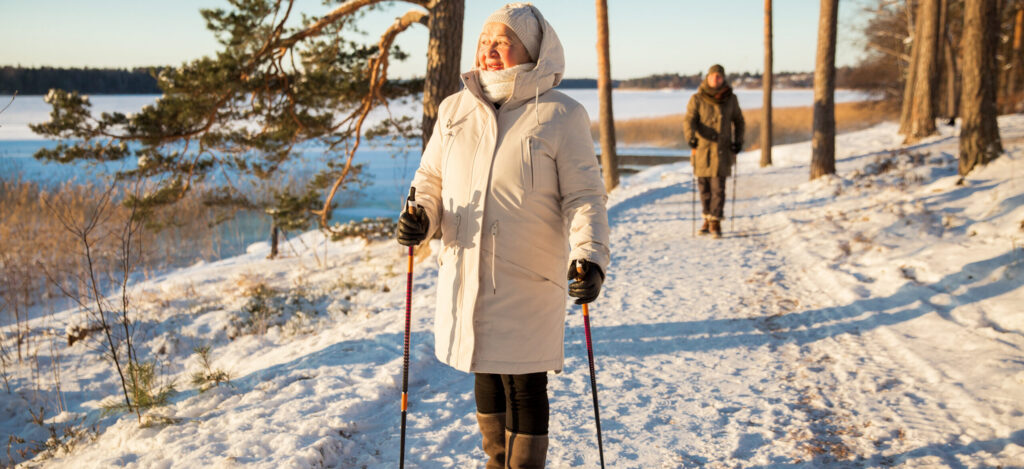
If you’ve noticed people clicking along sidewalks with ski-pole-looking sticks lately, they’re not lost cross-country skiers. They’re Nordic walkers, and this Finnish fitness trend is catching on in the United States as more people discover it’s basically a full-body workout disguised as a pleasant walk.
Nordic walking uses 80% to 90% of your muscles, compared to the 50% to 70% you engage during regular walking. That’s because those poles aren’t just for balance. You’re actively pushing off with each stride, engaging your arms, shoulders, back, and core in ways that regular walking simply doesn’t touch. Nordic walking burns roughly 20% more calories than regular walks, with some estimates putting the increase as high as 67%.
Cross-Country Skiing Without the Snow (Or the Skill)
The beauty of Nordic walking is accessibility. You don’t need snow, mountains, or athletic prowess. You just need poles, walking shoes, and the ability to coordinate your arms and legs, which most people master in about five minutes.
Ivan Semirechenskiy, vice president of the recently formed Nordic Walking Association of North America and a former Bolshoi Ballet soloist, used Nordic walking to recover from a spinal issue. “Some people think this is a senior sport, but it’s for everyone,” he told CNN. “It’s also a very social sport.”
There are actually Nordic walking competitions worldwide, with races ranging from 5K to 20K. Albert Fatikhov, president of the Nordic Walking Association of North America, won multiple medals at the 2024 International Nordic Walking Federation World Championships.

Why Winter Makes Sense
While Nordic walking works year-round, winter offers specific advantages that make it worth starting now rather than waiting for spring.
The poles provide extra stability on potentially slippery surfaces. With four points of contact with the ground instead of two, you’re significantly more stable, which matters when navigating patches of ice or uneven winter terrain. Research shows Nordic walking improves coordination and dynamic balance, making it particularly valuable during months when falls are more likely.
Winter walking can feel punishing on joints when temperatures drop. The poles distribute the force of each stride, reducing stress on hips, knees, and feet. You’re essentially offloading some of the impact that would normally hammer your lower body.
Nordic walking transforms a slog through cold weather into an actual workout worth doing. You’re burning significantly more calories in the same time you’d spend on a regular walk, making that 30-minute loop feel more productive.
The Technique Actually Matters
Nordic walking isn’t just regular walking while holding poles. The poles have built-in gloves that wrap around your palms, not the simple loops you’d find on hiking poles. This design lets you push off without gripping tightly, transferring more energy through your arms and shoulders.
The rubber tips are angled because you’re planting the pole around mid-foot or heel and pushing backward with each step. Get the technique wrong and you’re just carrying sticks around. Get it right and you’re essentially doing upper-body intervals while you walk.
It typically takes about five minutes to learn the basics and a few weeks for the movement to feel natural. Most people benefit from a lesson or two with a certified instructor, which you can find through the Nordic Walking Association or online tutorials.
What You Actually Need
True Nordic walking poles run $80 to $150, with brands like Leki, Swix, and Exel considered most reliable. The poles are adjustable, and the right height means your forearm sits at a 90-degree angle when you’re holding the pole upright.
You’ll want rubber tips for sidewalks and pavement (they come angled for the proper technique) and metal tips for trails. No special shoes required. Your regular walking shoes work fine, though waterproof options make sense for winter.
What the Research Shows
A 2022 randomized controlled trial found that Nordic walking boosted functional capacity in patients with coronary artery disease better than high-intensity interval training. Functional capacity is your ability to perform daily physical tasks like climbing stairs or carrying groceries.
Other studies show Nordic walking may reduce pain and fatigue in people with fibromyalgia, improve balance for those with stability issues, and provide a lower-impact alternative to jogging while delivering similar cardiovascular benefits.
For people with balance issues, the poles act as game-changers. Patients particularly love walking uphill with poles because the perceived effort feels dramatically less. The poles help with force generation going up and stability coming down.
Start with 10 minutes, then gradually increase until you’re comfortable doing 30-minute sessions five days per week. Stop immediately if you feel pain.