
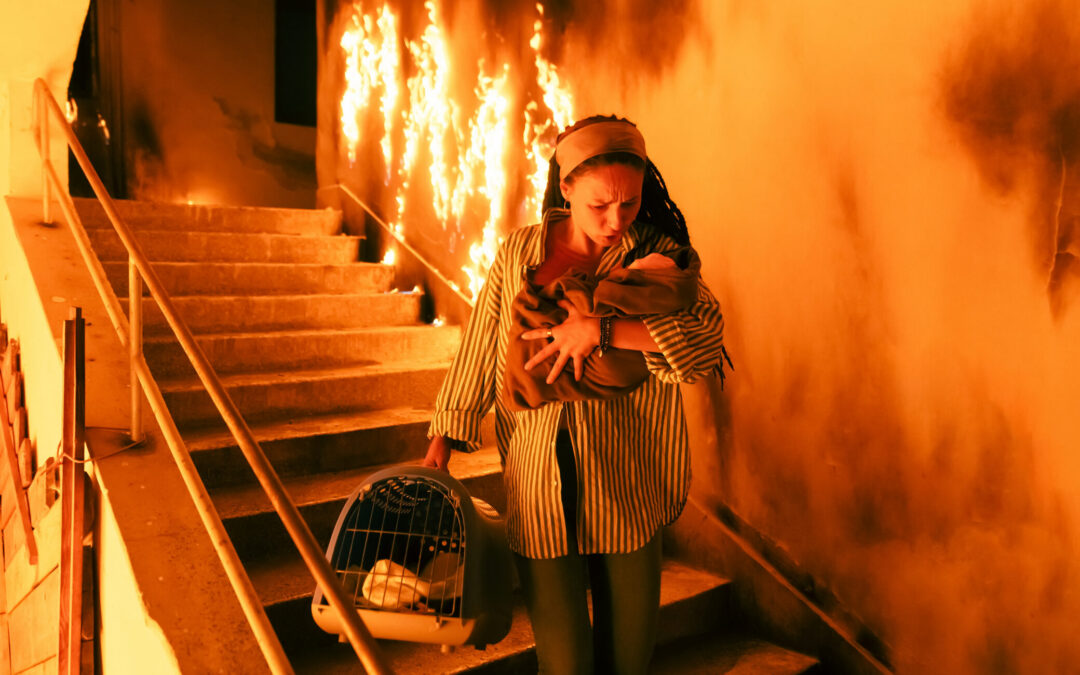
The shelling is getting closer. The neighbors left fifteen minutes ago. Everything rational says to go now. And yet a person pauses at the door, looks at the dog, and makes a decision that from the outside appears to make no sense.
Scenes like this have played out across Ukraine since the full-scale invasion began in 2022. Civilians fleeing drone attacks have carried dogs over their shoulders, tucked rabbits into backpacks, coaxed terrified cats into carriers at border crossings. Adults who have lost nearly everything refuse to leave without the one living thing that still greets them every morning.
To an outside observer this looks irrational. Risking your life for an animal under conditions defined by survival doesn’t compute. But the psychology behind the choice reveals something important about how the human mind sustains itself under prolonged stress.
The Mind’s Emergency Shutdown
When danger becomes continuous rather than episodic, something protective happens in the brain. Dr. Richard Mollica of Harvard Medical School’s Program in Refugee Trauma describes a phenomenon first identified by psychiatrist and historian Robert Jay Lifton as “psychic numbing” — a diminished capacity to feel that emerges when the alternative is being overwhelmed by fear.
Lifton first encountered the concept interviewing Hiroshima survivors. They described a moment when, surrounded by mass death, the emotional response simply stopped. “I saw everything,” one survivor told him, “but suddenly I simply ceased to feel anything.” The mind, confronted with more than it could process, shut off.
The numbness is adaptive — it allows people to keep functioning when fear should be paralyzing. Lifton described this closing-down as necessary, not a failure but psychological triage. The cost, over time, is that it works too well. People remain functional but increasingly hollow — still alive, but less and less capable of feeling it.
What a Dog Does That Nothing Else Can
This is where animals enter the equation in a way that is easy to dismiss and hard to replicate.
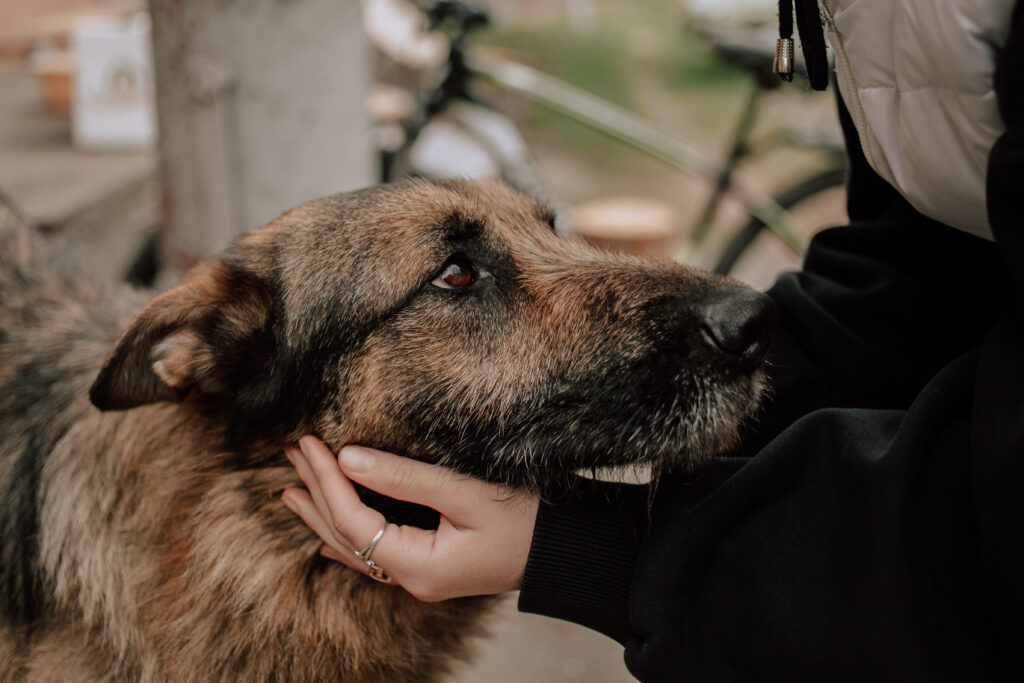
“You wake up in the morning with fear of death and annihilation,” Mollica explains. “And then your dog jumps on you, gives you love. For that moment, you are living in the present. You can feel again.”
What Mollica is describing is something specific: the ability of animal interaction to interrupt psychic numbing — not to resolve the trauma or eliminate fear, but to briefly, reliably restore the emotional responsiveness that chronic stress erodes. A cat’s weight on a chest. A dog bounding forward as though the world is fine. These are not comforts in the soft sense. They are neurological interruptions.
Research on human-animal interaction consistently finds that contact with animals reduces cortisol, lowers heart rate, and activates oxytocin pathways — effects that are rapid and involuntary, requiring no cognitive effort to achieve. In conditions where cognitive resources are already maxed out, that matters.
The decision not to abandon an animal isn’t irrational. It’s the preservation of the only reliable mechanism still available for feeling alive.
When the Bond Is Broken
The inverse is equally revealing. In the first year of Ukraine’s full-scale invasion, veterinary volunteers at train stations were euthanizing hundreds of abandoned animals every day — nowhere to shelter them, nothing to feed them as trains departed toward safety. Pavel Pavlovsky, a Ukrainian social worker, described the moral weight on those veterinarians: bearing witness to animal suffering and the grief of owners who had no choice but to leave. In some areas, the deliberate targeting of animals alongside churches and hospitals was understood as psychological warfare — an attack on the emotional infrastructure keeping people intact. Every animal lost is one fewer interruption in the numbing.
The Hidden Cost to Veterinarians

There is a layer to this story that receives almost no attention. Veterinarians operating in conflict zones are not simply treating animals — they are maintaining the psychological stability of the people who depend on them, while operating under the same conditions of threat and scarcity as everyone else. Even in peacetime, veterinarians have one of the highest suicide rates among healthcare professionals. War compounds every one of those stressors. Each animal they save helps preserve an owner’s mental stability. The cost is carried by the veterinarians themselves, largely in silence.
Not a Bad Calculation
The broader implication is simple but rarely stated: endurance under extreme conditions depends not only on physical safety but on the ability to remain emotionally connected to life. Animals, for millions of people navigating prolonged trauma, are one of the few things that reliably breach the numbing. The person who carries a dog out of a burning city isn’t making a bad calculation. They’re making a very good one — from a place of psychological knowledge they may not have words for, but their nervous system already understands.